

What Is SEO in Digital Marketing? A Complete Beginner’s Guide (2026)
Introduction
If you’ve ever searched for information on Google, you’ve already experienced the power of SEO in digital marketing. However, many beginners still ask the same question: What is SEO in digital marketing, and why is it so important?
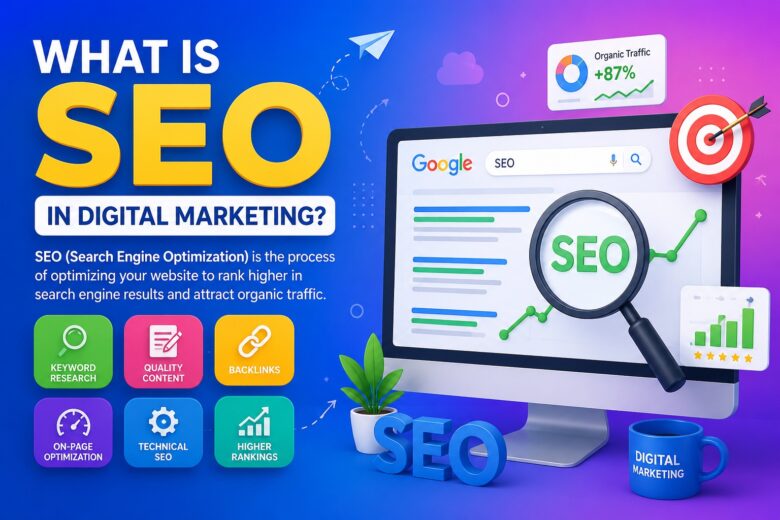
Simply put, Search Engine Optimization (SEO) is the process of improving a website so it appears higher in search engine results pages (SERPs). Instead of paying for every visitor through advertisements, SEO helps businesses attract organic traffic from search engines like Google, Bing, and Yahoo.
Moreover, SEO is one of the most cost-effective digital marketing strategies because it focuses on long-term growth rather than short-term results. As more businesses compete online, understanding SEO has become essential for website owners, bloggers, entrepreneurs, and digital marketers.
In this guide, you’ll learn what SEO is, how it works, its key components, benefits, best practices, common mistakes, and why it remains one of the most valuable digital marketing skills in 2026.
What Is SEO in Digital Marketing?
SEO (Search Engine Optimization) is a digital marketing strategy that improves a website’s visibility on search engines. The primary goal is to rank higher for relevant keywords so users can easily find your website when searching online.
For example, if someone searches “best running shoes,” Google displays the most relevant and trustworthy pages. Websites that follow SEO best practices have a better chance of appearing on the first page, where they receive the majority of clicks.
Therefore, SEO is not just about adding keywords. Instead, it involves creating valuable content, improving website performance, optimizing technical elements, and earning trust through high-quality backlinks.
Why Is SEO Important in Digital Marketing?
SEO plays a critical role in every successful digital marketing strategy. Without SEO, even the best website may struggle to attract visitors.
Here are some key reasons why SEO matters:
- Increases organic website traffic
- Builds credibility and trust
- Improves user experience
- Generates high-quality leads
- Delivers long-term results
- Reduces advertising costs
- Strengthens brand visibility
- Supports business growth
Furthermore, users tend to trust organic search results more than paid advertisements. As a result, businesses investing in SEO often enjoy higher conversion rates over time.
How Does SEO Work?
Search engines use advanced algorithms to decide which pages deserve the highest rankings.
Generally, SEO works through three major processes:
1. Crawling
Search engines send automated bots, often called spiders, to discover new pages across the internet.
2. Indexing
After crawling a page, search engines analyze its content and store it in their database.
3. Ranking
Finally, Google evaluates hundreds of ranking factors before deciding where a page should appear in search results.
Consequently, websites that provide helpful, relevant, and well-optimized content usually rank higher.
Types of SEO
SEO consists of several important categories, each contributing to better rankings.
1. On-Page SEO
On-page SEO focuses on optimizing elements within your website.
Examples include:
- Keyword optimization
- SEO-friendly titles
- Meta descriptions
- Heading structure
- Internal linking
- Image optimization
- URL optimization
- High-quality content
Additionally, creating content that satisfies user intent is one of the most important on-page SEO practices.
2. Off-Page SEO
Off-page SEO refers to activities performed outside your website to build authority.
Common techniques include:
- Backlink building
- Guest posting
- Brand mentions
- Social media promotion
- Influencer collaborations
- Digital PR
As your website earns backlinks, search engines begin to see it as more trustworthy.
3. Technical SEO
Technical SEO ensures search engines can easily crawl and understand your website.
Important technical factors include:
- Website speed
- Mobile responsiveness
- HTTPS security
- XML sitemap
- Robots.txt optimization
- Structured data
- Fixing broken links
- Core Web Vitals
Without strong technical SEO, even excellent content may struggle to rank.
Key Components of SEO
Successful SEO combines multiple strategies.
These include:
Keyword Research
Finding the exact words your audience searches for.
High-Quality Content
Publishing original, informative, and valuable content that answers users’ questions.
User Experience (UX)
Providing a fast, mobile-friendly, and easy-to-navigate website.
Backlinks
Receiving links from reputable websites to increase authority.
Content Updates
Regularly refreshing older articles to keep information accurate and relevant.
Together, these elements create a strong SEO foundation.
Benefits of SEO in Digital Marketing
SEO offers numerous advantages for businesses and individuals alike.
Some of the biggest benefits include:
- Higher search engine rankings
- Increased organic traffic
- Better brand awareness
- Improved website credibility
- More qualified leads
- Higher conversion rates
- Long-term marketing success
- Lower customer acquisition costs
- Better user experience
- Sustainable business growth
Moreover, unlike paid advertising, SEO continues generating traffic long after content is published.
Best SEO Practices
To improve your rankings, follow these proven SEO practices:
- Create original, helpful content.
- Use your primary keyword naturally.
- Optimize title tags and meta descriptions.
- Add internal and external links.
- Improve website loading speed.
- Make your website mobile-friendly.
- Optimize images with descriptive alt text.
- Update old content regularly.
- Build high-quality backlinks.
- Focus on user intent rather than keyword stuffing.
Most importantly, prioritize quality over quantity.
Common SEO Mistakes to Avoid
Many beginners unknowingly make SEO mistakes that hurt their rankings.
Avoid these common errors:
- Keyword stuffing
- Ignoring mobile optimization
- Duplicate content
- Slow website speed
- Poor internal linking
- Missing meta descriptions
- Broken links
- Thin or low-quality content
- Buying spammy backlinks
- Ignoring technical SEO
Instead, focus on creating value for your audience while following Google’s best practices.
Is SEO Still Worth Learning in 2026?
Absolutely.
Although search engine algorithms continue evolving, SEO remains one of the most effective digital marketing strategies.
In fact, AI-powered search, voice search, and user experience have made SEO even more important. Businesses that consistently publish high-quality, optimized content continue attracting organic traffic and generating long-term revenue.
Therefore, learning SEO is an excellent investment for bloggers, freelancers, entrepreneurs, and digital marketers.
Conclusion
So, what is SEO in digital marketing?
SEO is the process of optimizing a website to improve its visibility in search engine results and attract organic traffic. It combines keyword research, content creation, technical optimization, user experience, and backlink building to help websites rank higher on Google.
Furthermore, SEO provides long-term benefits, increases brand credibility, reduces marketing costs, and supports sustainable business growth. While results require patience and consistent effort, the rewards are well worth it.
Whether you’re starting a blog, growing an online business, or pursuing a career in digital marketing, mastering SEO is one of the smartest decisions you can make.
Frequently Asked Questions (FAQs)
1. What is SEO in digital marketing?
SEO (Search Engine Optimization) is the practice of improving a website’s visibility on search engines to attract organic traffic without paying for ads.
2. Why is SEO important?
SEO helps increase website traffic, improve brand visibility, build trust, and generate qualified leads while reducing long-term marketing costs.
3. What are the main types of SEO?
The three primary types are On-Page SEO, Off-Page SEO, and Technical SEO.
4. How long does SEO take to show results?
SEO typically takes 3 to 6 months to show noticeable improvements, although the timeline depends on competition, website quality, and consistency.
5. Is SEO better than paid advertising?
Both have advantages. Paid advertising delivers immediate traffic, whereas SEO provides sustainable, long-term organic growth.
6. Can beginners learn SEO?
Yes. With online resources, practical experience, and continuous learning, beginners can build strong SEO skills.
7. Does SEO still work in 2026?
Yes. SEO remains one of the most effective digital marketing strategies because search engines continue to prioritize high-quality, user-focused content.
8. What is the most important SEO ranking factor?
While Google uses many ranking factors, high-quality content, relevant keywords, user experience, page speed, and authoritative backlinks are among the most important.