


If you want to know how to start content marketing to grow your business, this complete guide will show you how to attract potential customers, build trust, and generate leads.
That is the opportunity behind content marketing.
Modern customers rarely purchase immediately after seeing an advertisement. They search Google, compare businesses, read reviews, watch videos, and look for answers before making a decision. If your business is absent during that research process, competitors have an opportunity to reach those customers first.
Content marketing helps your business become part of that journey.
What Is Content Marketing?

However, content marketing is much more than publishing blog posts. A successful strategy combines audience research, business goals, SEO, content creation, distribution, promotion, lead generation, and performance measurement.
This beginner-friendly guide explains how to start content marketing, what mistakes to avoid, and how to turn content into a long-term business asset.
Content marketing is the strategic creation and distribution of valuable, relevant, and useful content for a clearly defined audience with the goal of achieving a business objective.
Content can include:
- Blog posts
- Videos
- Case studies
- Newsletters
- Social media posts
- Podcasts
- Webinars
- Guides and eBooks
- Tutorials
- Checklists
- Research reports
The key word is valuable.
You are not creating content simply because every business is expected to have a blog. You are creating it because potential customers have questions, problems, concerns, and goals that your business can help them understand.
For example, a web design company could publish “How Much Does a Business Website Cost?”, “10 Signs Your Website Needs a Redesign,” or “How to Improve Your Website Conversion Rate.”
A reader may not be ready to buy immediately, but useful content introduces your company, demonstrates expertise, and builds familiarity.
That is the foundation of content marketing: provide value before asking for the sale.
How Content Marketing Works
The basic process is:
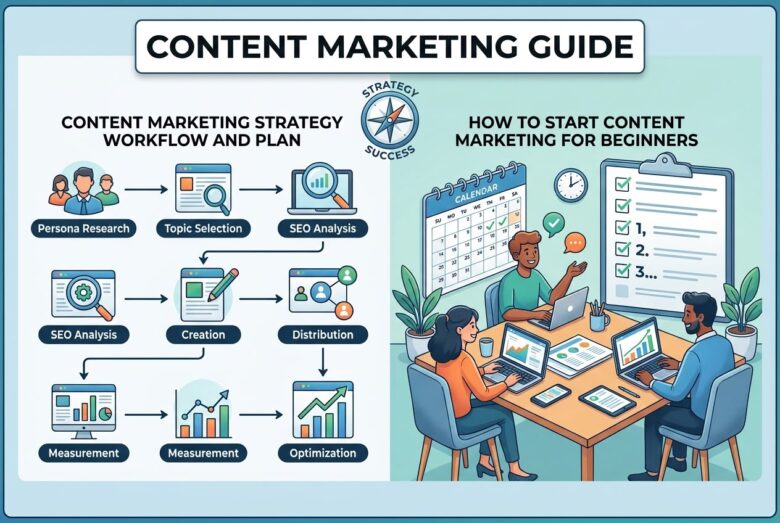
Understand your audience → identify their problems → create useful content → distribute it → build trust → encourage the next action → measure results → improve.
A potential customer might discover your business through Google, read an article, follow you on social media, subscribe to your email list, and eventually contact you after reading a case study.
The individual pieces of content work together to guide people through the buying journey.
Content Marketing vs. Traditional Advertising
Content marketing and advertising can work together.
Advertising pays for exposure and can produce immediate visibility. When the campaign stops, however, paid traffic usually stops as well.
Content marketing focuses on creating resources that can continue attracting attention through search, referrals, social media, email, and other channels.
Content marketing is not free—it requires research, strategy, writing, design, SEO, promotion, and measurement. But useful content can accumulate value over time.
Think of advertising as renting attention and content marketing as building an asset.
Why Content Marketing Matters
Content marketing allows small businesses, startups, freelancers, and professional service providers to compete through expertise rather than budget alone.
A small accounting firm, for example, may not outspend a national competitor on advertising. But it can create valuable content addressing specific problems faced by local business owners, such as bookkeeping, cash flow, invoicing, and tax preparation.
Content can also answer customer objections before a sales conversation.
Questions about pricing, timelines, risks, results, implementation, and comparisons can all become content opportunities.
Every unanswered customer question is potentially a content opportunity.
Define Your Content Marketing Goals
Before creating content, determine what business problem you want to solve.
Your goal might be to:
- Increase qualified leads
- Grow organic traffic
- Build industry authority
- Support sales
- Grow an email list
- Educate customers
- Increase online sales
Do not try to achieve everything at once.
Every piece of content should have a job to do.
For lead generation, focus on topics that attract potential buyers and include relevant conversion opportunities. For brand awareness, focus more on education, visibility, and audience growth.
Choose Measurable Objectives
Measure results according to your goals.
For organic growth, track search visibility, clicks, organic traffic, and relevant visitors.
For lead generation, track form submissions, email subscribers, qualified leads, consultation requests, and conversion rates.
For sales, examine revenue, assisted conversions, customer acquisition costs, and the influence of content on buying decisions.
Do not become obsessed with traffic alone.
The goal is not maximum traffic. The goal is valuable traffic.
Identify Your Target Audience
One of the biggest content marketing mistakes is trying to speak to everyone.
Understand your audience’s:
- Problems
- Goals
- Questions
- Concerns
- Buying objections
- Experience level
- Preferred platforms
- Decision-making process
Talk to existing customers when possible. Ask what they searched for before finding you, what nearly stopped them from buying, and what information they wish they had earlier.
These conversations can produce excellent content ideas.
Build a Simple Buyer Persona
Your persona does not need to be complicated.
Describe your ideal customer’s role, goals, frustrations, challenges, experience level, buying concerns, and information needs.
Instead of targeting “small businesses,” you might target small service businesses that rely on Google for leads but struggle to generate consistent website inquiries.
That immediately creates more specific topics, such as:
- How to Get More Leads from Google
- Why Your Business Website Is Not Generating Leads
- Local SEO Strategies for Service Businesses
- How to Improve Website Conversion Rates
Specific audiences create specific content.
Choose Your Content Niche
Your content niche should sit where three things overlap:
What your audience needs + what your business knows + what you can discuss consistently.
A focused niche makes it easier to establish expertise and attract relevant visitors.
You do not need to cover everything. Start focused and expand later.
Select the Right Content Formats
Different formats serve different purposes, and platforms like HubSpot offer templates to help structure them:
| Content Format | Best Use |
|---|---|
| Blog articles | SEO and education |
| Videos | Demonstrations and engagement |
| Case studies | Trust and conversions |
| Email newsletters | Audience nurturing |
| Social media posts | Awareness and distribution |
| eBooks and guides | Lead generation and education |
| Webinars | Education and high-intent leads |
| Testimonials | Social proof |
| Product comparisons | Purchase decisions |
Do not try to create everything.
Start with one primary format and one or two distribution channels that match your audience.
Build a Content Strategy
A strong content strategy should answer five questions:
- Who are we trying to reach?
- What problems are we solving?
- What business goals are we supporting?
- Where will we distribute the content?
- How will we measure success?
Create three to five content pillars around your core areas of expertise.
For a digital marketing agency, these might include SEO, content marketing, social media, email marketing, and lead generation.
These pillars provide structure and prevent your website from becoming a collection of unrelated topics.
Create a Content Calendar
For each piece of content, record:
- Topic
- Target audience
- Search intent
- Keyword
- Format
- Publication date
- Author
- Promotion channel
- Call to action
- Performance metrics
Choose a realistic publishing schedule. One excellent article every week is better than five weak articles followed by months of silence.
Also schedule content updates. Successful content should be improved rather than forgotten.
Conduct Keyword and Topic Research
Keyword research helps you understand what potential customers are searching for, but search volume is not everything.
Study search intent.
Someone searching “what is content marketing?” is learning.
Someone searching “best content marketing agency” is comparing providers.
Someone searching “content marketing agency pricing” may be closer to purchasing.
These users need different types of content.
Research questions, problems, comparisons, alternatives, buying concerns, and long-tail searches. Study competing results and look for opportunities to provide a better answer.
Your goal is not simply to insert keywords.
Your goal is to satisfy the reason behind the search.
Create High-Quality, People-First Content
High-quality content begins with research.
Understand the question, collect reliable information, add original insights, use examples, organize the material clearly, and write for real people.
Avoid:
- Keyword stuffing
- Repetitive paragraphs
- Generic introductions
- Unsupported claims
- Copying competitors
- Writing only to increase word count
A useful article should leave the reader thinking:
“That answered my question.”
There is no magic word count that guarantees rankings. A shorter article can outperform a much longer one if it provides a better answer.
Optimize Content for SEO
SEO helps search engines understand your content and helps users discover it.
Basic on-page SEO includes:
- Descriptive titles
- Clear headings
- Relevant keywords
- Readable URLs
- Internal links
- Useful external references
- Optimized images
- Descriptive alt text
- Strong meta descriptions
- Mobile-friendly pages
Use keywords naturally rather than forcing them into every paragraph.
Internal links can connect related topics and gradually turn your website into a knowledge hub.
Remember:
SEO gets people to the door. Great content gives them a reason to walk inside.
Distribute and Promote Your Content
Publishing is only half the job.
Depending on your audience, distribution channels may include:
- Google search
- YouTube
- Industry communities
- Partnerships
- Guest contributions
- PR
- Influencer collaborations
Do not try to dominate every platform. Choose the channels where your customers actually spend time.
After publishing, repurpose your content into social posts, short videos, emails, presentations, and sales resources.
One strong article can create many marketing assets.
Turn Content into Leads
Content becomes especially valuable when it creates opportunities for conversion.
Depending on the customer’s stage, your call to action could offer:
- A free consultation
- A downloadable guide
- A free audit
- A product demonstration
- A newsletter subscription
- A free trial
- A quote
- A contact opportunity
For example:
Want to know why your website is not generating enough leads? Request a free website and content audit.
The content provides value first, while the CTA gives interested readers a logical next step.
Measure Content Marketing Performance
Track metrics that connect content to business goals.
These may include:
- Organic traffic
- Search impressions
- Clicks
- Keyword visibility
- Email subscribers
- Leads
- Conversion rates
- Sales
- Revenue
- Assisted conversions
Do not judge content only by page views.
A small article that generates three valuable clients may be far more successful than a viral article that produces no business.
Measure outcomes, not just attention.
Common Content Marketing Mistakes
Avoid:
- Creating content without a strategy
- Targeting everyone
- Copying competitors
- Writing only for keywords
- Publishing low-quality content
- Forgetting promotion
- Ignoring calls to action
- Measuring only page views
- Giving up too early
According to the Content marketing institute, building visibility, authority, trust, and momentum takes time.
Build a Sustainable Workflow
A simple workflow is:
Research → Plan → Outline → Write → Edit → Optimize → Publish → Promote → Measure → Update.
Create reusable templates for content briefs, calendars, social posts, and performance reports.
Maintain a list of customer questions and content ideas. Review your best-performing topics and update them regularly.
This turns content marketing into a repeatable system rather than a collection of isolated activities.
Should You Hire a Content Marketing Professional?
You can start content marketing yourself, but creating content and building a complete content marketing engine are different things.
Professionals can help with:
- Audience research
- Content strategy
- Competitor research
- Keyword research
- Topic planning
- SEO
- Writing and editing
- Content design
- Distribution
- Lead generation
- Analytics
- Optimization
The value is not simply saving time. It is avoiding expensive mistakes and creating a strategy focused on business results.
If you are producing content but receiving little traffic or few leads, the problem may not be the amount of content. It may be the strategy behind it.
A Simple 90-Day Content Marketing Plan
Days 1–30: Build the Foundation
Define your audience, goals, niche, content pillars, competitors, keywords, formats, and distribution channels. Create your content calendar and publish your first high-value resources. Set up analytics.
Days 31–60: Publish and Promote
Publish consistently and promote every major piece. Repurpose your best content into social posts, emails, and videos. Begin building an email audience where appropriate.
Days 61–90: Analyze and Improve
Review your:
- Best-performing topics
- Highest-converting pages
- Most valuable keywords
- Strongest traffic sources
- Content gaps
- Weak-performing content
Then update, expand, and improve.
The goal after 90 days is not perfection. It is a repeatable content marketing system that becomes more effective over time.
Conclusion
Content marketing is not simply about writing blog posts.
It is about attracting the right people, answering their questions, earning their trust, demonstrating expertise, and guiding them toward becoming customers.
Start with your audience. Understand their problems. Define a business goal. Choose your niche. Research what people are searching for. Create useful content. Optimize it for SEO. Promote it through the right channels. Give readers a logical next step. Measure the results and improve continuously.
The businesses that succeed with content marketing are not necessarily those publishing the most. They are the businesses that understand their customers best.
When content becomes a long-term business asset rather than a publishing task, every article, video, guide, case study, and email can contribute to visibility, credibility, leads, and revenue.
You are not just creating content. You are building an audience, earning trust, and creating opportunities for your business to grow.
FAQs
1. How long does content marketing take to work?
Content marketing is a long-term strategy. Results depend on competition, industry, website authority, content quality, distribution, and consistency. Some channels can produce results quickly, while SEO-focused content may take several months to gain momentum.
2. How often should a business publish content?
There is no universal frequency. Choose a schedule your team can maintain without sacrificing quality. One excellent article every week can be more valuable than several weak articles.
3. Do small businesses need content marketing?
Content marketing can be particularly useful for small businesses because it allows them to demonstrate expertise and target specific customer needs without competing solely through advertising budgets.
4. Can content marketing generate customers?
Yes. Content can attract potential customers, educate them, overcome objections, demonstrate expertise, and guide them toward an offer. The key is connecting useful content with appropriate calls to action.
5. Should I hire a professional content marketing agency?
If you have the necessary time and expertise, you can manage content internally. However, strategy, research, SEO, production, distribution, conversion optimization, and analytics all require resources. Professional support can help businesses build a stronger system and avoid costly mistakes.
Ready to Turn Content Into a Growth Engine?
Creating content is easy. Creating content that attracts the right audience, ranks in search, builds authority, generates qualified leads, and supports revenue requires a strategy.
If your business is publishing content without seeing meaningful results, focus on the strategy behind the content—not simply producing more articles.
The right content, created for the right audience and distributed through the right channels, can become one of your most valuable long-term marketing assets.