


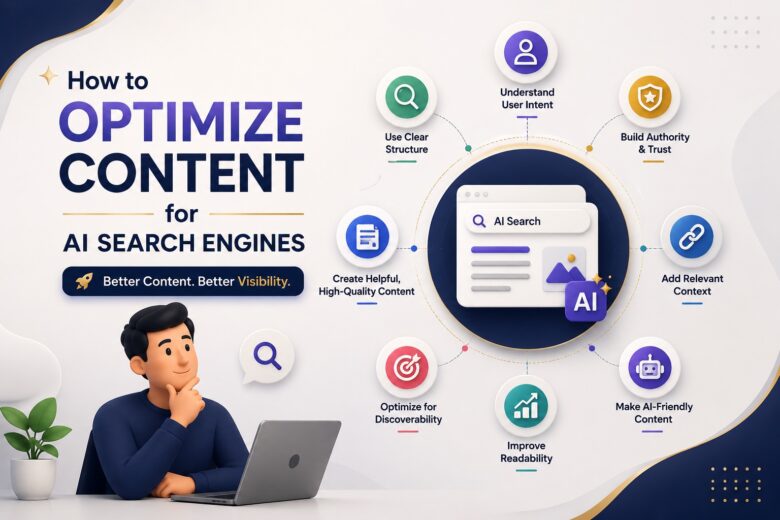
How to Optimize Content for AI Search Engines is becoming increasingly important as the way people find things online continues to change. More users are now asking detailed questions on AI platforms like ChatGPT Search, Google AI Overviews, Microsoft Copilot, and Perplexity. Instead of using only short keywords, they often ask complete questions and expect direct, useful answers. These platforms analyze information from multiple sources to provide clear and conversational responses. Learning How to Optimize Content for AI Search Engines can help businesses and content creators improve their visibility in AI-powered search results. The goal is to create useful, accurate, and easy-to-understand content that meets both user needs and AI search requirements.
Understand User Intent
Effective AI SEO starts with understanding user intent. Keywords show what people search for but don’t reveal their true needs. For example, if someone searches for “best smartphones for students,” they likely want recommendations, prices, specs, and comparisons. Simply repeating the keyword won’t help. Instead, provide useful information that guides readers to the right choice. Ask yourself: What problem is the user trying to solve? What information do they need? What question will they ask next?
When your content meets user needs, it becomes valuable for readers and easier for AI to understand.
Create High-Quality, Helpful Content
Content quality is key for successful SEO. AI search engines aim to provide useful answers. Generic articles focused on keywords offer little advantage.
Strong articles should be accurate, informative, relevant, and comprehensive. Rather than creating many shallow pieces, focus on building a valuable resource that answers the main question and covers key related topics.
Google emphasizes helpful, reliable, people-first content over mass content created just to rank higher.
Add Original Value
Consider: “What does my content offer that others don’t?”
Enhance your article by including:
- Real-world examples
- Case studies
- Original research
- Expert insights
- Practical experience
- Unique analysis
AI can summarize existing information easily. Your edge lies in providing genuinely useful and original insights.
Use a Clear Content Structure
AI search engines need to grasp how parts of your content relate. A clear structure helps both search engines and readers navigate your article.
Use one H1 heading for the main topic, organizing with relevant H2 and H3 headings. Each heading should clearly convey what follows.
Keep paragraphs focused on one main idea. Avoid unnecessary repetition and long blocks of text. Think of your article as a roadmap. If readers can follow it easily, search engines will too.
Optimize for Natural Language Queries
Traditional searches often use short phrases like “SEO tips” or “AI SEO.” AI searches are becoming more conversational. Users may ask, “How can I optimize my website for AI search engines?” Reflect this change in your content. Write in a conversational style that answers real questions. Include relevant questions and explanations where they fit naturally. Use your main and related keywords, but don’t force them into every paragraph.
The goal is to make your content sound natural while keeping it clear and relevant.
Build Authority and Trust
Trust is vital in AI-powered search. AI systems need reliable info to generate useful answers.
Build authority by showing expertise, providing accurate author info, citing credible sources, and backing important claims with evidence. Original research and practical examples can also strengthen your credibility.
Website reputation matters too. Quality backlinks, positive user experiences, consistent publishing, and strong brand recognition contribute to authority.
OpenAI recommends allowing OAI-SearchBot to crawl public content that publishers want to make discoverable through ChatGPT Search.
Improve Technical SEO
Even great content can’t perform well if search engines can’t access it. Technical SEO is crucial for AI search optimization.
Ensure your website is crawlable, indexable, mobile-friendly, and easy to navigate. Pay attention to page speed, robots.txt, indexing settings, canonical URLs, mobile responsiveness, and performance.
Google continues to stress making pages accessible to search engines and maintaining a good page experience.
Use Structured Data
Structured data helps search engines understand the information on a webpage. Depending on your content, relevant schema may describe an article, product, organization, breadcrumb, or other entity.
While structured data won’t guarantee higher rankings, it can provide context and make your content easier for search systems to interpret.
Keep Content Fresh and Updated
Information online changes constantly. Statistics become outdated, products evolve, and trends shift.
This is why content freshness matters. Regularly review important pages and update statistics, examples, screenshots, links, and recommendations as needed.
Updating content means making the article more accurate and useful, not just changing the publication date.
Ask yourself: “If someone reads this today, is the information still correct?”
If not, it’s time for an update.
Focus on User Experience
SEO isn’t just about search engines. It’s also about the person visiting your website.
A good user experience includes clear navigation, readable formatting, mobile-friendliness, fast loading times, and easy access to important information. Use headings, short paragraphs, bullet points, and tables to improve readability.
Avoid overwhelming readers with unnecessary design elements. The goal is simple: help visitors quickly and comfortably find what they need.
Optimize for AI Search Platforms
AI search platforms use various technologies, but they share similar basic needs. They must have content that is accessible, relevant, trustworthy, and easy to understand.
Google recommends following its established search guidance when creating content for AI Overviews and AI Modes. ChatGPT Search uses info from public websites. It can also give source links for its answers.
So, instead of searching for a secret “AI ranking trick,” focus on building a website that consistently offers useful information.
Measure and Improve Your Strategy
AI SEO isn’t a one-time task. After publishing content, check its performance and find ways to improve.
Track traditional metrics like organic traffic, impressions, rankings, clicks, and conversions. Keep an eye out for brand mentions, AI citations, and referral traffic from AI platforms when you can.
Bing offers AI-focused performance reporting to give publishers insight into how their content appears in AI-generated experiences.
Improve weak pages, update old info, and expand on strong topics using these insights.
FAQs
AI search optimization is the process of creating content that AI-powered search engines can easily discover, understand, and use to generate answers.
Yes. Technical SEO, quality content, backlinks, search intent, crawlability, and user experience still matter for AI search visibility.
Traditional search mainly presents links to webpages, while AI search analyzes many sources and generates direct answers, often with citations or links.
User intent helps you grasp what someone truly wants when searching. Content that solves a user’s problem is more valuable than content that just repeats keywords.
There’s no single magic factor. The best approach is to create helpful, original, accurate, trustworthy, and easy-to-understand content while maintaining strong technical SEO and user experience.