


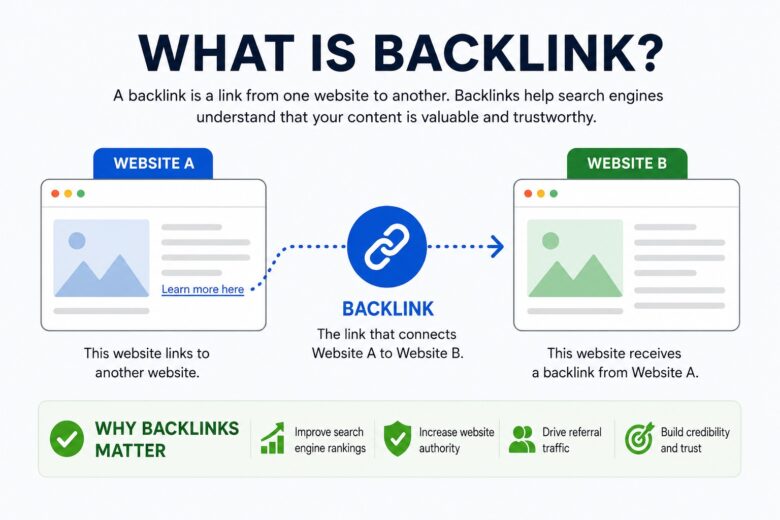
A backlink is a hyperlink from one website to another website. In SEO, backlinks are often called incoming links or inbound links. Search engines such as Google use backlinks as one of many signals to understand whether a webpage is trustworthy, relevant, and valuable. When an authoritative website links to your content, it can increase your site’s credibility and help search engines discover your pages more efficiently, In this guide you’ll learn what is backlink.
For example, if a technology blog publishes an article about “Best SEO Tools” and includes a link to your website, that link is considered a backlink for your site.
Why Are Backlinks Important?
Backlinks remain one of the strongest ranking signals in SEO because they indicate that other websites trust your content.
They help by:
- Improving search engine rankings
- Increasing website authority
- Driving referral traffic
- Helping search engines discover new pages faster.
- Building online credibility
Research continues to show a positive relationship between quality backlinks and higher search visibility. Pages with backlinks generally receive significantly more organic traffic than pages without them, although backlinks are only one part of Google’s ranking systems.
Types of Backlinks
| Type | Purpose | SEO Value |
| Dofollow | Passes ranking signals | High |
| Nofollow | Doesn’t normally pass ranking signals | Moderate |
| Sponsored | Identifies paid links | Limited |
| UGC | User-generated content links | Context-dependent |
Dofollow Backlinks
These are the standard backlinks that search engines can use as ranking signals.
Nofollow Backlinks
These contain the rel=”nofollow” attribute. While they generally don’t pass ranking signals in the traditional sense, they can still generate referral traffic and brand awareness.
Sponsored Links
Used for advertisements or paid partnerships.
UGC Links
UGC stands for User Generated Content and is commonly used for forum posts, blog comments, and community websites.
What Makes a High-Quality Backlink?
Not all backlinks are equally valuable.
The best backlinks usually come from websites that are:
- Relevant to your niche
- Trusted and authoritative
- Receiving genuine traffic
- Using natural anchor text
- Linking within useful content instead of footers or spam pages
A single backlink from a respected industry website can be far more valuable than hundreds of low-quality links.
How to Get Backlink
Some effective and ethical link-building strategies include:
1. Publish High-Quality Content
Create guides, research, tutorials, and original resources that others naturally want to reference.
2. Guest Blogging
Write useful articles for reputable websites in your industry and earn relevant backlinks.
3. Digital PR
Publish newsworthy content, original research, or expert insights that journalists and bloggers may cite.
4. Broken Link Building
Find broken links on other websites and suggest your relevant content as a replacement.
5. Resource Pages
Reach out to websites that maintain helpful resource lists and recommend your content if it’s genuinely useful.
How to Remove Backlink from Website
Backlink removal is the process of identifying and removing harmful or irrelevant inbound links from other websites that point to your website in order to maintain a healthy backlink profile.
- Use Google’s Disavow Tool if you cannot get harmful backlinks removed.
- Contact the website owner and request removal of the backlink.
- Remove links you control from your own websites or partner sites.
- Ask guest post publishers to remove or update the link if necessary.
Backlink vs Internal Links
| Backlinks | Internal Links |
| Come from other websites | Connect pages within your own website |
| Build authority | Improve navigation |
| Increase trust | Help search engines crawl your site |
| Can improve rankings | Distribute page authority |
Common Backlink Mistakes
Avoid practices such as:
- Buying spammy backlinks
- Using private blog networks (PBNs)
- Excessive link exchanges
- Keyword-stuffed anchor text
- Creating thousands of low-quality directory links
Modern SEO favors quality, relevance, and natural editorial links over sheer quantity.
Are Backlinks Still Important in 2026?
Yes. Backlinks continue to play an important role in traditional Google Search rankings, but they work alongside many other factors such as content quality, user experience, topical authority, and search intent. SEO experts increasingly emphasize earning relevant, trustworthy links instead of simply collecting large numbers of backlinks.
Conclusion
Backlinks are one of the foundations of successful SEO. They act as signals that other websites trust and recommend your content. While backlinks alone won’t guarantee top rankings, earning high-quality, relevant links through valuable content and ethical outreach can significantly improve your website’s visibility, authority, and organic traffic. Focus on creating content worth linking to, and build relationships within your industry instead of chasing low-quality links.
Frequently Asked Questions about what is back(FAQs)
A backlink is a link from another website that points to your website.
Yes. Quality backlinks remain an important ranking signal alongside content quality, relevance, and user experience.
A backlink comes from another website, while an internal link connects pages within the same website.
There is no fixed number. A few high-quality, relevant backlinks are generally more valuable than many low-quality ones.
Create valuable content, publish original research, write guest posts on reputable sites, and earn editorial mentions naturally rather than buying links.