


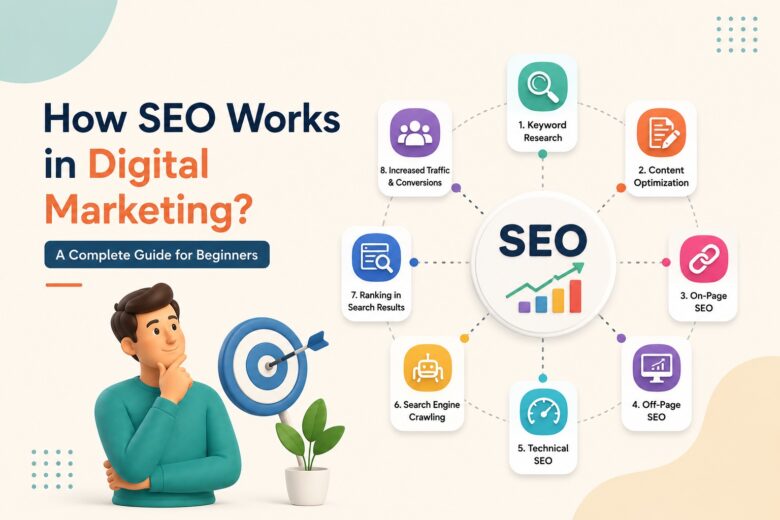
If you want to understand how SEO works in digital marketing, you need to understand how people find information and businesses online. Every day, millions of people use search engines like Google to find answers, products, services, and solutions. SEO, or Search Engine Optimization, helps businesses improve their visibility in organic search results so potential customers can discover them. Unlike paid advertising, SEO focuses on earning traffic by improving website content, relevance, structure, and user experience.
What Is SEO in Digital Marketing?
SEO is the process of optimizing a website so search engines can understand its content and show its pages to people searching for relevant information. When a user enters a query into Google, the search engine analyzes its available information and attempts to provide the most useful results.
For example, imagine you own a digital marketing agency. Someone searches for “best digital marketing agency for small business.” If your website contains helpful content about your services and clearly explains how you help small businesses, your page may be relevant to that search. However, SEO is not simply about adding keywords to a webpage. It includes content quality, search intent, technical performance, website structure, and credibility.
How Does SEO Work in Digital Marketing?
To understand how SEO works in digital marketing, it helps to understand how search engines organize websites. Search engines generally discover webpages through crawling, process and store information through indexing, and then display relevant pages when users perform searches.
During crawling, search engine bots discover webpages by following links and exploring websites. After finding a page, the search engine analyzes its content and other information. The page may then be stored in the search engine’s index.
When someone performs a search, the search engine evaluates relevant pages and determines which results may best satisfy the user’s needs. Various signals can influence rankings, including relevance, content quality, usability, and website structure. SEO helps businesses improve these areas so search engines can better understand their content and users can find useful information.
Main Types of SEO
SEO has several important areas, but the main categories are on-page, technical, and off-page SEO.
On-page SEO focuses on elements directly on your website. This includes page titles, headings, keywords, content structure, internal links, images, and content quality. The goal is to create useful, well-organized pages that answer your target audience’s questions.
Technical SEO focuses on the technical foundation of a website. This may include website speed, mobile usability, crawlability, indexability, site architecture and security. Even excellent content may struggle if search engines cannot properly access or understand your website.
Off-page SEO focuses on activities outside your website. Back links from relevant and trustworthy websites are one example. Brand mentions, digital PR, and content promotion can also help strengthen online credibility. The best approach is to earn genuine recognition by creating valuable content and building relationships.
Why Are Keywords Important in SEO?
Keywords are an important part of understanding how SEO works in digital marketing. A keyword is a word or phrase that people type into search engines. Keyword research helps businesses understand what their target audience is searching for and what topics they want to learn about.
However, successful SEO is not about repeating a keyword as many times as possible. Search intent is equally important. Search intent refers to the reason behind a user’s search.
For example, someone searching for “what is SEO” is probably looking for educational information. Someone searching for “SEO agency for small business” may be looking for professional services. By understanding search intent, businesses can create content that matches what users actually want.
How SEO Helps Businesses Grow in digital marketing
SEO helps businesses connect with potential customers while they are actively searching for information, products, or services. When a website ranks for relevant keywords, users can discover the business through organic search without the company paying for every click.
One major advantage of SEO is its long-term potential. Paid advertising can provide immediate visibility, but traffic usually depends on an ongoing advertising budget. SEO requires time and consistent effort, but useful content can continue attracting organic visitors over a longer period.
SEO can also help build brand awareness and trust. When people repeatedly find your website while searching for useful information, they may begin to recognize your business as a reliable resource. This can support the customer journey from initial research to purchase.
How Long Does SEO Take to Work?
SEO does not normally produce instant results. The timeline depends on factors such as competition, website age, content quality, technical performance, authority, and consistency.
A new website competing in a highly competitive industry may take longer to gain visibility. An established website may see improvements faster after updating content or fixing technical issues.
For this reason, businesses should treat SEO as a long-term digital marketing strategy. Regularly publishing useful content, improving existing pages, and monitoring performance can help build stronger organic visibility over time.
How to Measure SEO Success
Measuring SEO performance is important because rankings alone do not tell the whole story. Common SEO metrics include organic traffic, impressions, clicks, click-through rate, keyword rankings, leads, conversions, and revenue.
Google Search Console can help website owners understand how their pages perform in Google Search by providing information about queries, impressions, and clicks. Analytics tools can also show what visitors do after reaching the website.
The ultimate goal of SEO is not simply to rank number one. The real objective is to attract the right audience and turn relevant organic traffic into meaningful business results.
Conclusion
Understanding how SEO works in digital marketing is essential for businesses that want to grow online. SEO combines quality content, keyword research, search intent, technical optimization, website usability, and authority-building activities to improve organic search visibility.
The best SEO strategy focuses on users first. Create useful content, answer real questions, optimize your website, and make information easy for search engines and visitors to understand. With patience and consistent effort, SEO can become a valuable long-term source of organic traffic, leads, customers, and business growth.
Frequently Asked Questions About SEO(FAQ)
SEO stands for Search Engine Optimization. It is the process of optimizing a website and its content to improve organic visibility and attract relevant visitors from search engines.
SEO helps search engines discover, understand, and evaluate website content. Businesses use quality content, keywords, technical optimization, and authority-building strategies to improve their chances of appearing in relevant search results.
There is no fixed time frame. Competition, website authority, content quality, technical performance, and consistency can all affect how quickly SEO produces results.
Both have different benefits. Paid advertising can provide immediate visibility, while SEO focuses on building long-term organic traffic. Many businesses use both strategies together.
Keywords help businesses understand what their target audience searches for. Using relevant keywords naturally and matching search intent can help connect content with the right users.