


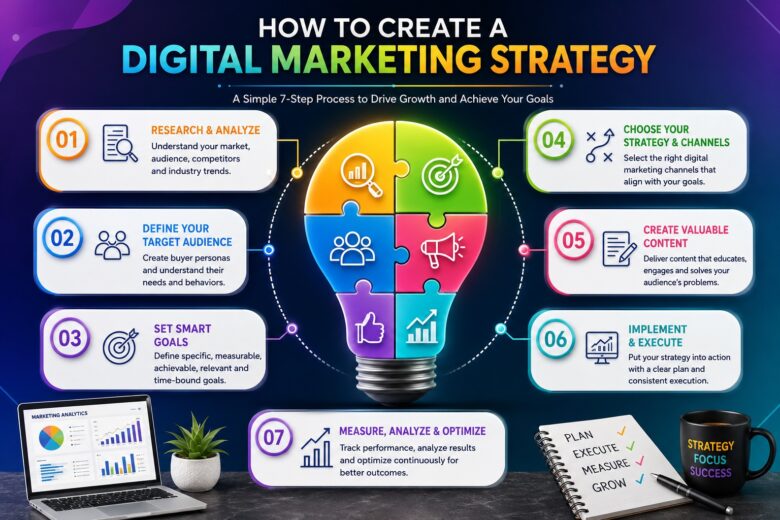
Create a digital marketing strategy is one of the most important steps for businesses looking to grow online. Whether you own a small business, manage an eCommerce store, or work as a digital marketer, a well-planned strategy helps you attract the right audience, generate quality leads, and increase sales.
A successful digital marketing strategy combines SEO, content marketing, social media, email marketing, paid advertising, and analytics into a single, well-organised plan. Instead of randomly posting content or running ads, you create measurable goals and focus on activities that deliver results.
This guide explains how to build an effective digital marketing strategy from scratch.
What Is a Digital Marketing Strategy?
A digital marketing strategy is a structured plan that outlines how a business will use digital channels to achieve marketing objectives.
It identifies:
- Business goals
- Target audience
- Marketing channels
- Content plan
- Budget
- Performance metrics
- Timeline
The objective is to connect with potential customers while maximising return on investment (ROI).
Why Is a Digital Marketing Strategy Important?
Without a strategy, marketing efforts often become inconsistent and ineffective.
Benefits Include
- Better brand awareness
- Increased website traffic
- Higher search engine rankings
- Improved customer engagement
- More qualified leads
- Better conversion rates
- Higher ROI
- Clear performance measurement
Step-by-Step Guide to Create a Digital Marketing Strategy
Step 1: Define Your Business Goals
Start by identifying what you want to achieve.
Examples include:
| Goal | KPI |
| Increase website traffic | Organic visitors |
| Generate leads | Lead submissions |
| Improve sales | Revenue |
| Build brand awareness | Social reach |
| Increase email subscribers | Subscriber growth |
| Improve customer retention | Repeat purchases |
SMART Goals
Your goals should be:
- Specific
- Measurable
- Achievable
- Relevant
- Time-bound
Example:
Increase organic website traffic by 35% within the next six months.
Step 2: Identify Your Target Audience
Knowing your audience helps create personalised marketing campaigns.
Consider
- Age
- Gender
- Income
- Education
- Location
- Interests
- Buying behavior
- Online activity
Example Buyer Persona
| Attribute | Details |
| Age | 30 |
| Profession | Marketing Manager |
| Goal | Grow business online |
| Challenge | Limited marketing budget |
| Preferred Platform | |
| Searches | Digital marketing tips |
Step 3: Analyze Your Current Digital Presence
Review your existing marketing efforts.
Website
Check:
- Mobile friendliness
- Loading speed
- SEO
- Navigation
- User experience
Social Media
Review:
- Engagement
- Followers
- Reach
- Posting frequency
Email Marketing
Analyse:
- Open rate
- Click-through rate
- Conversion rate
SEO
Review:
- Keyword rankings
- Backlinks
- Organic traffic
- Indexed pages
Step 4: Perform Competitor Research
Analyse successful competitors to discover opportunities.
Study:
- Website structure
- Content quality
- Keywords
- Backlinks
- Social media strategy
- Paid advertisements
Useful SEO Tools
| Tool | Purpose |
| Google Analytics | Traffic analysis |
| Google Search Console | SEO monitoring |
| SEMrush | Keyword research |
| Ahrefs | Backlink analysis |
| Moz | Domain authority |
| Ubersuggest | SEO research |
Step 5: Choose Your Digital Marketing Channels
Not every business needs every marketing channel.
SEO
SEO stands for ‘Search Engine Optimisation’. It is the process of improving a website so that it ranks higher in search results from search engines like Google, Bing, and Yahoo, helping attract more organic (unpaid) visitors.
Benefits:
- Long-term traffic
- High ROI
- Brand authority
Content Marketing
Content Marketing is a digital marketing strategy that focuses on creating, publishing, and distributing valuable, relevant, and consistent content to attract and retain a clearly defined audience. The ultimate goal is to encourage profitable customer actions, such as making a purchase, signing up for a newsletter, or contacting a business.
Publish:
- Blog posts
- Guides
- Videos
- Infographics
- Case studies
High-quality content builds trust and improves SEO.
Social Media Marketing
Social Media Marketing (SMM) is the process of using social media platforms to promote a business, brand, product, or service. It involves creating and sharing engaging content, interacting with audiences, running advertisements, and analysing performance to achieve marketing goals such as increasing brand awareness, generating leads, and driving sales.
Popular platforms include the following:
- X (Twitter)
- TikTok
- YouTube
Each platform serves different audiences and goals.
Email Marketing
Email Marketing is a digital marketing strategy that uses email to communicate with current and potential customers. It helps businesses build relationships, promote products or services, nurture leads, and increase sales through targeted and personalised messages.
Use email to:
- Share newsletters
- Promote products
- Offer discounts
- Build customer relationships
Pay-Per-Click (PPC)
Pay-Per-Click (PPC) is a digital advertising model where advertisers pay a fee each time someone clicks on their advertisement. Instead of earning traffic organically through SEO, PPC allows businesses to buy visits to their website by placing ads on search engines, social media platforms, and other websites.
Popular options:
- Google Ads
- Facebook Ads
- Instagram Ads
- LinkedIn Ads
Step 6: Develop a Content Strategy
Content is the foundation of digital marketing.
Create Content That Solves Problems
Examples:
- How-to guides
- Tutorials
- Industry news
- FAQs
- Product reviews
- Checklists
Content Calendar Example
| Week | Content |
| Week 1 | Blog article |
| Week 2 | Video tutorial |
| Week 3 | Social media campaign |
| Week 4 | Email newsletter |
Consistency improves audience engagement.
Step 7: Optimize for SEO
SEO helps your content rank higher in search engines.
On-Page SEO
Optimise:
- Title tag
- Meta description
- URL
- Headers
- Images
- Internal links
Off-Page SEO
Focus on:
- Quality backlinks
- Guest posting
- Brand mentions
- Social sharing
Technical SEO
Improve:
- Website speed
- Mobile responsiveness
- SSL certificate
- XML sitemap
- Structured data
Step 8: Set a Marketing Budget to Create a Digital Marketing Strategy
Allocate your budget according to business priorities.
Example:
| Channel | Budget |
| SEO | 30% |
| Content Marketing | 20% |
| Social Media | 20% |
| PPC Advertising | 20% |
| Email Marketing | 10% |
Adjust spending based on campaign performance.
Step 9: Track Key Performance Indicators (KPIs)
Monitor your progress regularly.
Important KPIs include:
- Website traffic
- Organic rankings
- Bounce rate
- Conversion rate
- Cost per lead
- Customer acquisition cost
- Return on investment
- Social engagement
Step 10: Continuously Improve Your Strategy
Digital marketing is constantly evolving.
Regularly:
- Review analytics
- Update old content
- Test new campaigns
- Optimize landing pages
- Improve SEO
- Adjust ad budgets
- Experiment with new channels
Continuous optimisation leads to better long-term results.
Essential Components of a Successful Digital Marketing Strategy
| Component | Importance |
| Business Goals | High |
| Audience Research | High |
| SEO | High |
| Content Marketing | High |
| Social Media | High |
| Email Marketing | Medium |
| PPC Advertising | Medium |
| Analytics | High |
| Conversion Optimization | High |
Best Practices for Digital Marketing Success
- Set clear and measurable goals.
- Understand your ideal customer.
- Focus on creating valuable content.
- Optimise every page for SEO.
- Use multiple marketing channels strategically.
- Build an email list.
- Maintain a consistent publishing schedule.
- Monitor analytics frequently.
- Conduct A/B testing to improve campaigns.
- Stay updated with digital marketing trends and search engine algorithm changes.
Common Mistakes to Avoid
- Ignoring SEO
- Targeting the wrong audience
- Publishing inconsistent content
- Neglecting mobile optimization
- Failing to track campaign performance
- Depending on only one marketing channel
- Setting unrealistic goals
- Overlooking customer feedback
- Not updating outdated content
- Ignoring website speed and user experience
Digital Marketing Strategy Checklist
- Define business objectives
- Identify target audience
- Analyze competitors
- Conduct keyword research
- Optimize website SEO
- Create valuable content
- Build social media presence
- Launch email campaigns
- Invest in paid advertising
- Track analytics
- Optimize continuously
Conclusion
Creating a digital marketing strategy is not about using every available marketing channel—it is about choosing the right combination that aligns with your business goals and audience. By defining clear objectives, understanding your customers, optimising your website for SEO, producing high-quality content, and measuring results, you can build a sustainable strategy that drives long-term growth.
Remember that digital marketing is an ongoing process. Regular testing, analysis, and optimisation will help you stay competitive and maximise your return on investment. Businesses that consistently refine their strategy are better positioned to attract customers, strengthen their online presence, and achieve lasting success.
Frequently Asked Questions to Create a Digital Marketing Strategy
A digital marketing strategy is a structured plan that outlines how a business will use online channels such as SEO, content marketing, social media, email, and paid advertising to achieve specific marketing goals.
It helps businesses focus their marketing efforts, reach the right audience, improve ROI, increase brand awareness, and measure campaign performance effectively.
The main components include business goals, audience research, SEO, content marketing, social media marketing, email marketing, PPC advertising, analytics, and conversion optimisation.
Paid advertising may generate results within days, while SEO and content marketing typically take 3–6 months to show significant improvements.
There is no single best channel. The most effective approach combines SEO, content marketing, social media, email marketing, and paid advertising, tailored to your business goals and target audience.
Review your strategy at least quarterly, and make adjustments whenever business objectives, customer behaviour, or market conditions change.
Popular tools include Google Analytics, Google Search Console, SEMrush, Ahrefs, Moz, Ubersuggest, Canva, Mailchimp, and HubSpot for analytics, SEO, content creation, email marketing, and campaign management.