

How Technical SEO Impacts Organic Search Traffic
When it comes to search engine optimization (SEO), most website owners and marketers immediately think of keyword research, high-quality copywriting, and building authority through backlinks. While these elements are undeniably critical, they represent only half of the equation. You can publish the most informative, well-researched content on the web, but if search engines cannot access, read, or navigate your website efficiently, your organic traffic will flatline.How Technical SEO Impacts Organic Search Traffic
This is where technical optimization comes into play. Understanding How Impacts Organic Search Traffic is essential for anyone looking to scale their digital presence, improve search engine rankings, and secure sustainable, long-term growth.
What is Technical SEO?
Technical SEO refers to optimizing your website’s backend infrastructure to help search engine bots (like Googlebot) crawl, render, index, and understand your pages more effectively. Unlike o—which focuses on text, headings, and keywords—technical SEO deals with website speed, site architecture, security, mobile responsiveness, and structural code.
Think of your website as a physical retail store. Your content and keywords are the products on the shelves, and your backlinks are the recommendations that bring people to your door. Technical SEO is the physical building itself: if the doors are locked, the aisles are blocked, or the lights are out, customers (and search engines) will quickly leave frustrated.
Think of your website as a physical retail store. Your content and keywords are the products on the shelves, and your backlinks are the recommendations that bring people to your door. Technical SEO is the physical building itself: if the doors are locked, the aisles are blocked, or the lights are out, customers (and search engines) will quickly leave frustrated.
The Direct Link Between Technical SEO and Organic Traffic
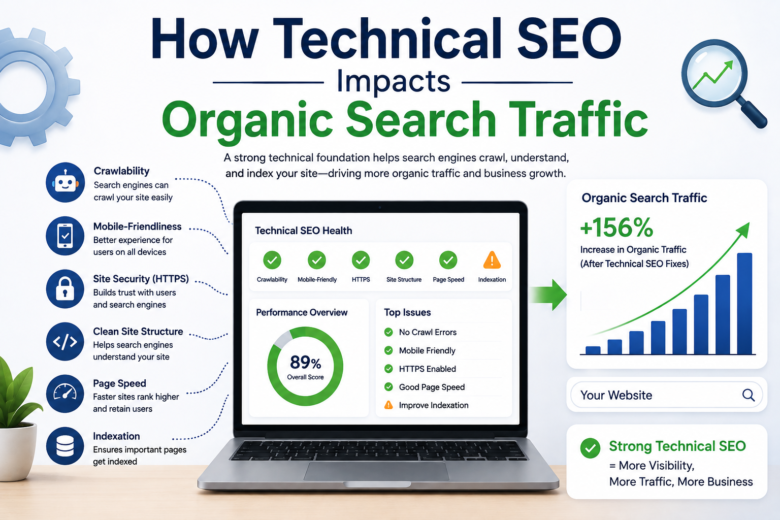
Technical SEO serves as the foundation that enables all other optimization efforts to succeed. Here is a closer look at how specific technical factors directly influence your organic search traffic:
Crawlability and Indexability
Search engines discover new and updated content by sending automated bots to crawl websites. If your site has a messy site architecture, broken links, or an unoptimized robots.txt file, search bots may waste their time or get blocked entirely.
• The Impact: If Google cannot crawl and index your pages, they will not appear on Search Engine Results Pages (SERPs). Fixing crawl errors ensures that your latest content gets discovered and ranked faster, leading to a direct surge in organic visibility.
Search engines discover new and updated content by sending automated bots to crawl websites. If your site has a messy site architecture, broken links, or an unoptimized robots.txt file, search bots may waste their time or get blocked entirely.
• The Impact: If Google cannot crawl and index your pages, they will not appear on Search Engine Results Pages (SERPs). Fixing crawl errors ensures that your latest content gets discovered and ranked faster, leading to a direct surge in organic visibility.
Core Web Vitals and Page Speed
Google’s Core Web Vitals measure user experience metrics related to loading speed, visual stability, and interactivity. Slow-loading pages frustrate users, resulting in high bounce rates and low engagement.
• The Impact: Google prioritizes user experience. Websites that load within seconds consistently outrank slower competitors. When you optimize your server response times, leverage browser caching, and compress images, you lower bounce rates and signal to search engines that your site deserves higher rankings, driving more consistent organic traffic.
Google’s Core Web Vitals measure user experience metrics related to loading speed, visual stability, and interactivity. Slow-loading pages frustrate users, resulting in high bounce rates and low engagement.
• The Impact: Google prioritizes user experience. Websites that load within seconds consistently outrank slower competitors. When you optimize your server response times, leverage browser caching, and compress images, you lower bounce rates and signal to search engines that your site deserves higher rankings, driving more consistent organic traffic.
- Mobile-First Optimization
With the majority of global web traffic originating from mobile devices, Google uses mobile-first indexing. This means it predominantly uses the mobile version of your content for indexing and ranking.
• The Impact: If your website is difficult to navigate on a smartphone, has text overlapping, or takes too long to render on mobile networks, your rankings will drop significantly. Ensuring a seamless, responsive mobile design protects your organic traffic from declining as mobile search behavior grows.
- HTTPS and Security
Security is a non-negotiable ranking factor. Websites utilizing HTTP lack encryption, leaving user data vulnerable and triggering “Not Secure” warnings in modern web browsers.
• The Impact: Migrating to HTTPS via an SSL certificate builds immediate trust with both your visitors and search engine algorithms. Secure sites are prioritized in search results, safeguarding your organic reach and protecting your users’ privacy. - Structured Data (Schema Markup)
Structured data provides explicit clues about a page’s meaning to search engines. Implementing schema markup helps search engines generate rich snippets, such as review stars, FAQs, pricing details, and event listings directly on the SERPs.
• The Impact: While schema may not directly boost baseline rankings, rich results drastically improve Click-Through Rates (CTR). A higher CTR means more people choose your link over competitors, resulting in increased organic traffic even with the same ranking position.
Frequently Asked Questions (FAQs)
- What is the difference between on-page SEO and technical SEO?
• On-page SEO focuses on the content visible to users, including keyword placement, title tags, meta descriptions, headings, and overall content quality. Technical SEO deals with the backend elements of your website that users don’t directly see—such as site speed, XML sitemaps, URL structure, and server performance—ensuring search engines can access and process your site smoothly. - How often should I perform a technical SEO audit?
• It is recommended to perform a comprehensive technical SEO audit every 3 to 6 months, or immediately after making major website changes (such as a platform migration, redesign, or massive URL restructuring). Regular audits help catch broken links, slow pages, and indexing errors before they hurt your organic traffic. - Can technical SEO alone increase my organic traffic?
• Technical SEO creates the healthy foundation required for success, but it works best in tandem with great content and authoritative backlinks. Think of it this way: technical SEO removes barriers so your content can rank, while great content and keywords determine how high it ranks. - What are Core Web Vitals, and why do they matter for traffic?
• Core Web Vitals are a specific set of metrics established by Google to quantify user experience. They measure Largest Contentful Paint (LCP) for loading speed, Interaction to Next Paint (INP) for responsiveness, and Cumulative Layout Shift (CLS) for visual stability. Passing these metrics improves user satisfaction, which directly correlates with better search rankings and sustained organic traffic. - Does technical SEO affect local search visibility?
• Yes, heavily. Search engines evaluate local landing pages based on mobile-friendliness, speed, structured data consistency (NAP information), and local crawlability. A strong technical setup ensures your local business appears prominently in Google’s Map Pack and localized search results.