

Meta Title: How to Improve SEO with Digital Marketing | Complete Guide (2026)
Meta Description: Learn how to improve SEO with digital marketing using proven strategies including content marketing, social media, technical SEO, email marketing, PPC insights, and analytics to increase rankings and organic traffic.
How to Improve SEO with Digital Marketing
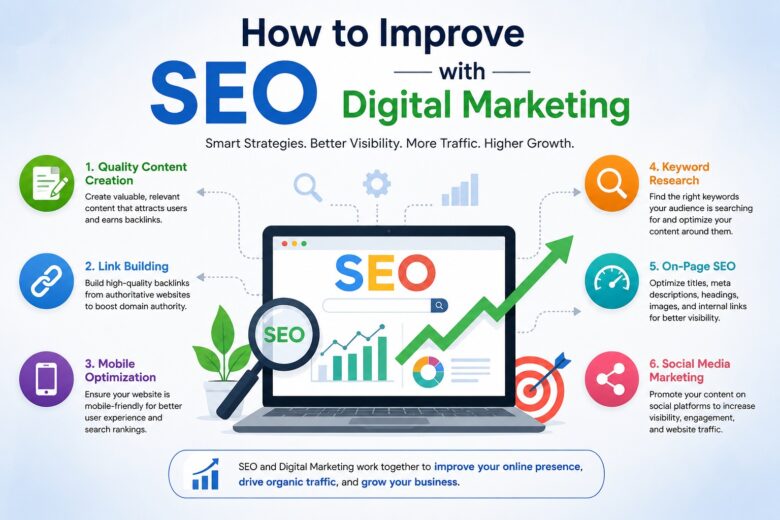
Search Engine Optimization (SEO) and digital marketing work best when they support each other. While SEO helps your website rank higher in search engine results, digital marketing increases your brand visibility, attracts high-quality visitors, and improves user engagement. When combined, these strategies create sustainable online growth.
Whether you own a small business, an eCommerce store, or a corporate website, understanding how to improve SEO with digital marketing can significantly increase your website traffic, lead generation, and conversion rates.
What is SEO in Digital Marketing?
SEO (Search Engine Optimization) is the process of optimizing your website so that search engines like Google can easily understand, crawl, and rank your content.
Digital marketing includes multiple online channels such as:
- Content Marketing
- Social Media Marketing
- Email Marketing
- Search Engine Marketing (SEM)
- Pay-Per-Click (PPC)
- Video Marketing
- Influencer Marketing
- Online Reputation Management
Together, these channels strengthen your SEO performance by increasing authority, engagement, and backlinks.
Why SEO Matters in Digital Marketing
Businesses that invest in SEO receive long-term benefits compared to those that rely solely on paid advertising.
Key Benefits
- Increase organic website traffic
- Improve Google rankings
- Build brand authority
- Generate high-quality leads
- Increase website credibility
- Improve user experience
- Lower customer acquisition costs
- Deliver long-term marketing ROI
SEO vs Digital Marketing
| Feature | SEO | Digital Marketing |
| Primary Goal | Improve search rankings | Promote products and services |
| Traffic Source | Organic | Organic + Paid |
| Cost | Lower long-term | Depends on campaign |
| Results | Long-term | Short and long-term |
| Main Focus | Website optimization | Multiple marketing channels |
| ROI | High over time | Depends on strategy |
15 Proven Ways to Improve SEO with Digital Marketing
1. Perform Smart Keyword Research
Everything begins with keyword research.
Choose keywords based on:
- Search volume
- Keyword difficulty
- Search intent
- Competition
- Conversion potential
Include:
- Primary keywords
- Secondary keywords
- Long-tail keywords
- Question-based keywords
- Local keywords
Example:
Primary Keyword:
How to Improve SEO with Digital Marketing
Supporting Keywords:
- SEO digital marketing strategy
- Improve website SEO
- Digital marketing SEO tips
- Organic traffic growth
- Google ranking factors
2. Create High-Quality Content
Google rewards websites that publish helpful and original content.
Create:
- How-to guides
- Tutorials
- Case studies
- Industry news
- Expert articles
- Checklists
- Ultimate guides
Good content should:
- Answer user questions
- Include examples
- Be easy to read
- Use headings correctly
- Include internal links
3. Optimize On-Page SEO
Each webpage should contain:
Essential On-Page Elements
- SEO-friendly URL
- Optimized title tag
- Meta description
- H1 heading
- H2 and H3 headings
- Image ALT text
- Internal links
- External authority links
- Schema markup
4. Improve Website Speed
Fast websites rank better.
Ways to improve speed:
- Compress images
- Enable caching
- Minify CSS and JavaScript
- Use a CDN
- Upgrade hosting
- Reduce redirects
5. Make Your Website Mobile-Friendly
More than half of web traffic comes from mobile devices.
Ensure your website:
- Uses responsive design
- Loads quickly
- Has readable fonts
- Features easy navigation
- Includes clickable buttons
6. Use Content Marketing
Publishing useful content consistently builds authority.
Content types include:
- Blog posts
- Videos
- Infographics
- Podcasts
- eBooks
- Webinars
Fresh content encourages repeat visits and improves search visibility.
7. Build High-Quality Backlinks to Improve SEO with Digital Marketing
Backlinks remain one of Google’s strongest ranking signals.
Earn links by:
- Guest posting
- Digital PR
- Creating shareable resources
- Publishing research
- Building industry relationships
Avoid buying low-quality backlinks, as they can harm your rankings.
8. Leverage Social Media Marketing
Although social signals are not direct ranking factors, social media helps by:
- Increasing content visibility
- Driving referral traffic
- Building brand awareness
- Encouraging natural backlinks
- Expanding audience reach
Share every new blog post across your social channels.
9. Improve User Experience (UX)
Google values websites that provide a positive user experience.
Improve UX by:
- Simplifying navigation
- Reducing bounce rates
- Enhancing readability
- Using clear calls to action
- Improving page design
10. Optimize for Local SEO
Local businesses should:
- Optimize their business profile
- Collect customer reviews
- Use location-based keywords
- Create local landing pages
- Maintain consistent contact information
11. Use Video Marketing
Videos increase engagement and time spent on your website.
Ideas include:
- Product demonstrations
- Tutorials
- Customer testimonials
- Educational content
- Industry updates
Embed videos within blog posts to enrich the user experience.
12. Optimize Technical SEO
Technical SEO ensures search engines can crawl and index your site effectively.
Checklist:
- XML sitemap
- Robots.txt
- HTTPS
- Canonical URLs
- Structured data
- Core Web Vitals
- Broken link fixes
13. Monitor Performance
Use analytics tools to measure:
- Organic traffic
- Bounce rate
- Conversion rate
- Keyword rankings
- Page speed
- Click-through rate (CTR)
Regular monitoring helps identify opportunities for improvement.
14. Update Existing Content
Refreshing older content can improve rankings without creating new articles.
Update:
- Statistics
- Screenshots
- Keywords
- Internal links
- FAQs
- Examples
Aim to review important pages every 6–12 months.
15. Focus on EEAT
Google values content that demonstrates:
- Experience
- Expertise
- Authoritativeness
- Trustworthiness
Strengthen EEAT by:
- Citing reliable sources
- Displaying author information
- Keeping content accurate and current
- Earning reputable backlinks
Complete SEO and Digital Marketing Checklist
| Task | Importance | Frequency |
| Keyword Research | High | Monthly |
| Content Creation | High | Weekly |
| On-Page SEO | High | Every Page |
| Technical SEO Audit | High | Quarterly |
| Backlink Building | High | Ongoing |
| Internal Linking | Medium | Monthly |
| Website Speed Optimization | High | Monthly |
| Mobile Optimization | High | Ongoing |
| Analytics Review | High | Weekly |
| Content Updates | High | Every 6–12 Months |
SEO Performance Analysis
| SEO Factor | Impact on Ranking | Difficulty | Expected Results |
| Keyword Optimization | Very High | Medium | High |
| Quality Content | Very High | Medium | High |
| Technical SEO | High | Medium | High |
| Backlinks | Very High | High | High |
| Page Speed | High | Low | Medium |
| Mobile Optimization | High | Low | Medium |
| User Experience | High | Medium | High |
| Social Promotion | Medium | Low | Medium |
| Internal Linking | Medium | Low | Medium |
| Content Refresh | High | Low | High |
Analysis: Businesses that consistently combine technical SEO, valuable content, user experience improvements, and digital marketing promotion tend to achieve more stable rankings than those focusing on SEO alone. Organic growth compounds over time, making SEO one of the most cost-effective digital marketing investments.
Estimated SEO and Digital Marketing Costs
| Service | Small Business (Monthly) | Medium Business (Monthly) | Enterprise (Monthly) |
| SEO Audit | $200–$800 | $800–$2,000 | $2,000+ |
| Content Creation | $300–$1,500 | $1,500–$5,000 | $5,000+ |
| Technical SEO | $300–$1,000 | $1,000–$3,000 | $3,000+ |
| Link Building | $500–$2,000 | $2,000–$6,000 | $6,000+ |
| Social Media Marketing | $300–$2,000 | $2,000–$5,000 | $5,000+ |
| Email Marketing | $100–$1,000 | $1,000–$3,000 | $3,000+ |
| Total Estimated Monthly Budget | $1,000–$8,300 | $8,300–$24,000 | $24,000+ |
Costs vary based on industry, competition, geographic market, and whether services are handled in-house or by an agency.
Common Mistakes to Avoid
- Publishing duplicate or AI-generated content without editing
- Ignoring search intent
- Stuffing keywords unnaturally
- Neglecting technical SEO
- Using slow web hosting
- Forgetting image optimization
- Buying spammy backlinks
- Failing to update old content
- Ignoring mobile users
- Not tracking SEO performance
Best Practices
- Publish helpful, original content consistently.
- Target keywords that match user intent.
- Optimize every page for speed and mobile usability.
- Build authoritative backlinks naturally.
- Strengthen internal linking between related pages.
- Track SEO metrics and refine your strategy regularly.
- Update evergreen content to keep it relevant.
- Prioritize user experience alongside search engine optimization.
Conclusion
Improving SEO with digital marketing requires more than optimizing keywords—it involves creating valuable content, delivering an excellent user experience, promoting content across multiple channels, and continuously measuring results. By integrating SEO with content marketing, social media, technical optimization, email campaigns, and analytics, businesses can build long-term visibility, increase qualified traffic, and generate sustainable growth in an increasingly competitive online landscape.
Frequently Asked Questions: How to Improve SEO with Digital Marketing
Digital marketing supports SEO by increasing brand awareness, driving referral traffic, attracting backlinks, improving user engagement, and amplifying high-quality content.
Content marketing is generally the most effective because it creates valuable resources that attract organic traffic, backlinks, and user engagement. Social media and email marketing also help distribute that content.
SEO provides long-term organic traffic and sustainable results, while paid advertising delivers immediate visibility. A balanced strategy often combines both.
Many websites begin to see measurable improvements within 3 to 6 months, while highly competitive industries may require 6 to 12 months or longer.
Social media is not a direct ranking factor, but it increases content exposure, referral traffic, and opportunities to earn natural backlinks.
Review your SEO strategy quarterly, monitor performance monthly, and update key content every 6–12 months or whenever significant industry changes occur.
There is no single ranking factor. High-quality content, search intent, technical SEO, page experience, authoritative backlinks, and EEAT all work together to improve rankings.
Yes. By focusing on keyword research, valuable content, local SEO, technical optimization, and consistent publishing, small businesses can achieve strong organic growth with a modest budget.