

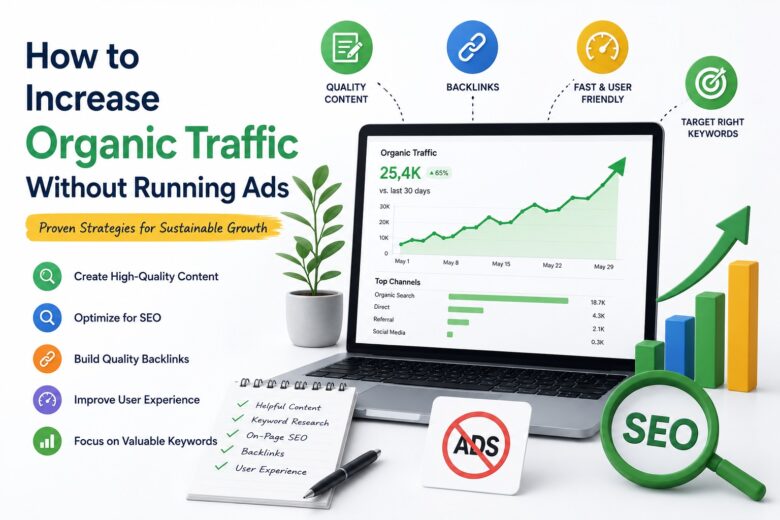
Every website owner wants to see thousands of visitors from Google for free. Organic traffic is now one of the most valuable digital assets for any business. Organic traffic continues to bring visitors even after you publish your content. This differs from paid campaigns. Those stop working once the budget is gone. You can increase organic traffic without running ads.
Why Organic Traffic Matters More Than Ever
Picture this: you open a retail store in the busiest shopping area. You don’t pay rent for every customer who enters. That is essentially what organic traffic offers. You don’t need to buy ads on every platform. Instead, create valuable content. This earns you visibility with search engines.
Organic visitors usually convert better than paid ones. This is because they actively seek solutions. A person searching for “best CRM software for small businesses” wants to find a product. When your website gives a clear answer, visitors are more likely to trust your brand. This is better than if they click on a random ad. This natural buying intent makes organic traffic incredibly valuable.
Organic Traffic Paid Traffic
Free clicks Pay for every click.
Long-term growth Short-term results
Higher trust Lower trust for some users
Better ROI over time Immediate visibility
Builds authority Stops when the budget ends.
Understand Your Audience Before Creating Content
Many websites fail because they focus on what they want to publish rather than what users actually need. Successful SEO starts with understanding your audience. Before writing a single paragraph, ask yourself a simple question: What problem is my reader trying to solve?
Every search begins with an intention. Someone searching “how to increase organic traffic without running ads” is not looking for a definition of SEO. They want practical, actionable advice that they can implement immediately.
Knowing your target keyword’s category helps you create content that meets user needs. Google rewards pages that satisfy intent better than competitors.
Find Low-Competition Keywords
Choosing the wrong keywords is one of the fastest ways to waste months of effort. Many beginners go after very competitive terms. These are often led by big brands that have years of authority. Ranking for those keywords is difficult, especially for newer websites. A smarter approach is to focus on low-competition keywords that still attract qualified visitors.
One effective strategy is keyword clustering. Instead of writing 10 separate articles for similar phrases, make one comprehensive resource. This will cover various topics in a more natural way.
Long-Tail Keywords
Long-tail keywords often face less competition. They also have higher conversion rates since they match specific search intent. They might get fewer searches on their own. However, together, they can bring in a lot of traffic and are easier to rank for.
People search using complete questions every day:
- How do I get more organic traffic?
- Why is my website not ranking?
- How long does SEO take?
- Is organic traffic better than paid traffic?
Create High-Quality Content That Solves Real Problems
The internet already contains millions of articles covering almost every topic imaginable. Publishing another generic post that repeats common advice will rarely help you rank. Search engines prioritize content that offers unique value. They like clear explanations, practical examples, and real expertise. Instead of asking, “How can I write another article on this topic?” ask, “How can I create the most useful resource available?”
Optimize On-Page SEO for Better Rankings
Creating excellent content is only half the battle. Search engines depend on on-page SEO signals. These signals help them know what your page is about. They also decide if your page should rank highly. Even the most informative article can struggle to rank if its title, headings, URLs, and internal links are poorly optimized. Think of on-page SEO as organizing a library.
Crafting an Engaging Title: Put Your Keyword First
A strong title boosts rankings. It also raises click-through rates.
Improve Website Speed and User Experience
Imagine clicking a search result only to wait several seconds for the page to load. Most users will simply leave and choose another result. Website speed is now a key ranking factor. Search engines aim to give users fast and enjoyable experiences. A slow website not only increases bounce rates but also reduces conversions and visitor satisfaction.
Improving page speed begins with optimizing images. Uploading large, uncompressed images is one of the most common reasons websites become sluggish. Compress images while keeping quality. Use modern formats like WebP when you can.
Optimization Area SEO Benefit
Faster loading pages Lower bounce rate
Mobile-friendly design Better mobile rankings.
Image compression Improved page speed
Browser caching Faster repeat visits.
Clean navigation Better user engagement
Build Topical Authority Instead of Chasing Individual Keywords
Many website owners focus on ranking a single article for a single keyword. While this approach can generate traffic, it rarely creates long-term authority. Modern search engines like websites that show expertise in a whole subject, not just single topics. This is known as topical authority, and it has become one of the strongest indicators of a trustworthy website.
Earn High-Quality Backlinks Naturally
Backlinks are key ranking signals. They act like recommendations from other websites. When reputable sites link to your content, search engines interpret those links as votes of confidence. The goal, however, is not to collect hundreds of low-quality links. A handful of authoritative backlinks often provides far greater value than dozens of irrelevant ones.
The easiest way to attract backlinks is by publishing content people genuinely want to reference. Original research, industry stats, tutorials, templates, free tools, and case studies earn citations. They save others time and effort. Journalists, bloggers, and content creators often use reliable sources for their articles.
Optimize for AI Search and Google AI Overviews
Search behavior is evolving rapidly. More users get answers directly from AI search tools before clicking on regular search results. Websites now need to optimize for more than just traditional rankings. They must also focus on AI-generated summaries and answer engines. The main idea is simple: make content accurate, complete, and easy to understand.
Rather than fearing AI, view it as another opportunity. Websites that share quality, user-friendly content can improve their search rankings. They also benefit from new AI search experiences.
Track Performance and Improve Continuously
SEO is not a one-time project. Search algorithms evolve, competitors publish new content, and user expectations change over time. Monitoring performance allows you to identify opportunities before traffic begins to decline. Successful websites see Technical SEO as a continuous cycle. They measure, experiment, and improve regularly.
Updating existing content is one of the highest-return SEO activities.
Refresh stats.
- Replace old screenshots.
- Expand brief sections.
- Answer new user questions.
- Strengthen internal links.
Small updates can refresh old articles and help them recover lost rankings. This can be done without having to create new content.
Common SEO Mistakes to Avoid
Many websites struggle not because they lack effort but because they repeat the same avoidable mistakes. Understanding these pitfalls can save months of frustration and significantly improve your results.
One common mistake is focusing exclusively on search engines instead of readers. Keyword stuffing, awkward writing, and repetitive headings used to work. But now, today’s algorithms favor content that is truly helpful. Another mistake is publishing many short, low-value articles. Instead, focus on creating fewer, more comprehensive resources. Quality consistently outperforms quantity in modern SEO.
Conclusion
You can boost organic traffic without ads. It takes a solid strategy, not quick fixes. Success starts with knowing your audience. Target the right keywords and publish valuable content. Optimize each page for users and search engines. Then, keep improving your website using performance data. Organic SEO builds over time. Unlike paid ads, it creates a lasting asset. This asset keeps bringing in visitors even after articles are published.
Frequently Asked Questions(FAQ)
Most websites see noticeable improvements in three to six months. However, competitive industries may need more time. Consistency and content quality have a major impact on results.
Yes. Many new websites grow by:
Using keyword research
Creating high-quality content
Ensuring strong internal linking
They also focus on technical SEO. Best of all, they do this without spending any money on ads.
Writing detailed content on low-competition long-tail keywords is a smart way to attract qualified visitors for free.
Yes. High-quality backlinks from trusted sites are still a key ranking signal. They must be earned naturally, not bought.
No. AI search changes how we see information, but the core stays the same. Helpful, trustworthy, and well-structured content meets user intent. This type of content performs best in both traditional and AI-powered searches.