


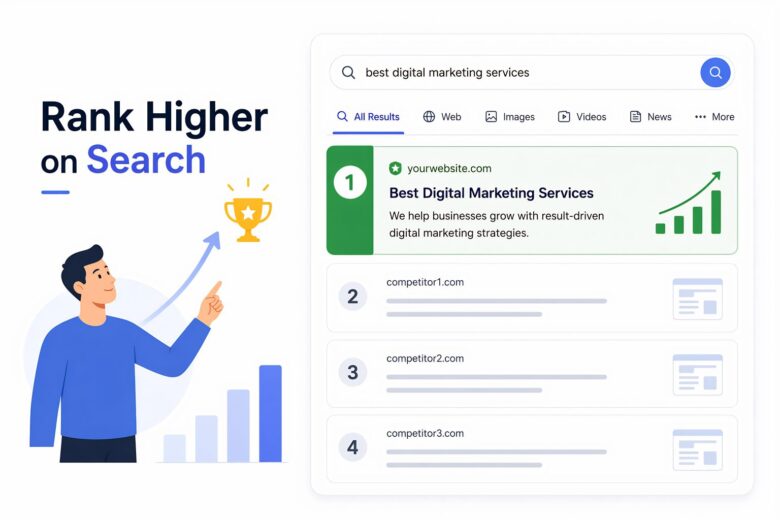
Introduction to Modern SEO
Ranking higher on Google search in 2026 is no longer about tricks. It is about understanding how Google thinks, how users behave, and how content delivers value. Search engines have become extremely intelligent, using AI and behavioral signals to determine what deserves visibility. According to recent SEO research, Google now evaluates content based on quality, user satisfaction, and authority rather than just keywords alone .
If you are still using outdated SEO methods like keyword stuffing or low-quality backlinks, you are basically trying to win a Formula 1 race with a bicycle. SEO today is more like building a reputation system rather than just optimizing a webpage. In this article, you will learn how to rank higher on google search and how to align your website with Google’s expectations in 2026.
Understanding Google’s Ranking System
Google doesn’t rank websites randomly. It uses hundreds of signals to evaluate relevance, authority, and user satisfaction. In fact, modern SEO research suggests Google considers over 200 ranking factors when ordering search results .
At the core, Google tries to answer one question: Does this page solve the user’s problem better than others? That means ranking is less about optimization hacks and more about problem-solving clarity. If users click your page and immediately return to search results, Google interprets that as dissatisfaction.
Search Intent and User Satisfaction
Search intent is the foundation of modern SEO. Every query has a purpose—informational, transactional, or navigational. If your content doesn’t match intent perfectly, it won’t rank, no matter how optimized it is.
For example, if someone searches “how to lose weight fast,” they expect actionable steps, not a scientific essay. Google tracks whether users stay on your page or bounce back. High engagement signals help boost rankings.
AI-Powered Ranking Signals
Google now uses AI systems to interpret content meaning instead of just matching keywords. This means your content must be contextually rich. It should answer related questions naturally, not just repeat a keyword. AI understands topics like humans now, so shallow content gets filtered out quickly.
Why Traditional SEO Is No Longer Enough
Old SEO strategies focused heavily on keyword density, backlinks, and exact-match optimization. While these still matter, they are no longer enough to compete.
Keyword Stuffing vs. Semantic SEO
Keyword stuffing is dead. Google now prioritizes semantic SEO, which means understanding meaning instead of repetition. If your article repeats “best shoes for running” too many times without depth, it will likely be ignored.
Instead, semantic SEO focuses on related concepts like cushioning, durability, foot type, and terrain. This creates a natural content ecosystem that Google trusts.
Core Google Ranking Factors in 2026
Modern ranking depends on multiple interconnected signals. Among them, content quality is the strongest factor influencing visibility today.
Content Quality and Depth
Content must fully answer the user’s question. Thin or shallow articles no longer perform well. Google prefers comprehensive content that explains topics deeply and clearly.
High-ranking pages usually:
- Cover subtopics in detail.
- Include real examples
- Provide actionable steps
- Answer follow-up questions
E-E-A-T (Experience, Expertise, Authority, Trust)
E-E-A-T has become central to SEO. Google wants to know:
- Who wrote the content?
- Do they have real experience?
- Can the information be trusted?
For example, medical or financial content without expertise signals will struggle to rank. Trust is now a ranking currency.
Importance of Topical Authority
Topical authority means being recognized as an expert in one specific subject area. Instead of writing random articles, websites now need focused content clusters.
Topic Clusters Strategy
A topic cluster system includes:
- One main pillar page
- Multiple supporting articles
- Internal linking between them
For example, a website about fitness might have:
- Main page: “Complete Fitness Guide.”
- Supporting pages: nutrition, workouts, recovery, supplements
This structure signals deep expertise to Google.
On-Page SEO Optimization
On-page SEO is still important, but must be done naturally. Google now looks for clarity and structure rather than keyword manipulation.
Title Tags and Meta Descriptions
Your title should clearly describe the page content. Avoid click bait. Meta descriptions should summarize value in a human-friendly way.
Internal Linking Structure
Internal links help Google understand your website structure. They also guide users to related content, increasing engagement and session duration.
Technical SEO Essentials
Technical SEO ensures your website is easy for Google to crawl and understand.
Core Web Vitals
Core Web Vitals measure:
- Page loading speed
- Interactivity
- Visual stability
Fast-loading websites rank better because they improve user experience.
Mobile-First Indexing
Google primarily uses mobile versions of websites for indexing. If your site is not mobile-friendly, your rankings will suffer significantly.
Backlinks and Digital Authority
Backlinks are still important, but their role has evolved. It is not about how many links you have—it is about where they come from.
Quality vs. Quantity of Links
A single backlink from a trusted site is more powerful than 100 low-quality links. Google now evaluates the authority of linking domains more strictly.
User Experience Signals
Google tracks how users interact with your site.
Bounce Rate and Dwell Time
If users leave quickly, it signals poor content quality. If they stay longer, it signals value. These behavioral signals directly influence rankings.
Content Strategy for Ranking Higher
Content is still the backbone of SEO, but strategy matters more than ever.
Long-Form Content Importance
Long-form content tends to perform better because it covers topics deeply. However, length alone is not enough—it must be useful and structured.
AI and Future of SEO
Search is becoming more AI-driven, meaning Google may answer questions directly without users clicking websites.
AI Overviews and Zero-Click Searches
Many searches now end without clicks because Google shows instant answers. To adapt, content must be optimized for featured snippets and AI summaries.
Local SEO Optimization
Local SEO is essential for businesses targeting specific areas.
Google Business Profile Optimization
A fully optimized Google Business Profile improves visibility in map results and local searches. Reviews, categories, and updates play a big role.
Common SEO Mistakes to Avoid
Many websites fail due to simple mistakes:
- Ignoring search intent
- Overusing keywords
- Publishing thin content
- Poor site structure
- Buying low-quality backlinks
Avoiding these mistakes alone can improve rankings significantly.
Step-by-Step Ranking Strategy
To rank higher on Google:
- Research search intent
- Create in-depth content
- Build topic clusters
- Optimize on-page SEO
- Improve site speed
- Earn high-quality backlinks
- Monitor user behavior
Consistency is key. SEO is not a one-time effort but an ongoing process.
Conclusion
Ranking higher on Google in 2026 is about trust, relevance, and user satisfaction. The days of shortcuts are gone. Instead, success comes from creating meaningful content that genuinely helps people. If your website consistently delivers value, Google will eventually reward it with higher visibility.
Think of SEO as building a reputation, not just ranking pages. The stronger your authority, the easier it becomes to rank for competitive keywords.
Frequently Asked Questions
It usually takes 3–6 months, depending on competition, content quality, and domain authority.
Yes, but quality matters more than quantity. Relevant and authoritative links are most valuable.
Content quality and user satisfaction are the strongest ranking signals today.
Yes, but only if it is edited, valuable, and meets user intent properly.
Updating content every few months helps maintain rankings and improves freshness signals.